
The New English Art Club – one of Britain’s oldest and most prestigious art societies – was founded 140 years ago in 1886. As the NEAC celebrates this milestone with its 140th Anniversary Exhibition at Mall Galleries, Archivist Neil Pittaway reflects on the heritage and history that have shaped the society.
What does “THE New English Art Club” actually mean?
The title ‘The New English’ may seem outdated to some, but it remains as relevant today as in 1886, reflecting the NEAC’s ongoing role as a prominent club in British art. Originally, the name embodied a ‘new’ approach to painting at the end of the 19th century – primarily French Impressionism and plein‑air techniques – pioneered by our founders, who aimed to observe and capture the world with fresh perspectives beyond the academic traditions of the Royal Academy at the time. Our club remains dedicated to promoting these principles whilst thoughtfully exploring our world today.
The ‘English’ in the club’s title reflects the encouragement and fostering of a new generation of predominantly English/British artists, providing them with a promotional platform from which they could experiment and be proponents of the ‘new’ and avant‑garde, being largely influenced by the French Impressionists. Indeed, one of our early members was Lucien Pissarro, the son of the famous French Impressionist painter Camille Pissarro. He thought so highly of England and our club that he moved to London, exhibited with us, and was elected to the NEAC in 1906, after which he became a British citizen.

Gatti’s Hungerford Palace of Varieties. Second Turn of Katie Lawrence (ca. 1888) by Walter Richard Sickert (1860-1942), Image courtesy of the Yale University Art Gallery.
Sir Walter Richard Sickert, an early and influential NEAC member, was close to Claude Monet, who exhibited with the NEAC in its early years. Sickert’s connection with Monet introduced French Impressionism to Britain, a tradition that continues in plein‑air painting among many of our members today.”
How did the NEAC evolve through the World Wars and the interwar years?
“During the First and Second World Wars, and the interwar periods, the NEAC continued to establish itself as a national arts organisation. It transitioned from an avant‑garde protest group to a firmly established and distinguished force in British art. Its outlook broadened, gaining acceptance and recognition from the British arts establishment, including the Royal Academy, with many NEAC members later elected as Royal Academicians.
Around the time of the First World War, the NEAC included a new generation of British artists such as Clare Atwood, Sir William Orpen, John Singer Sargent, Paul Nash, John Nash, Sir Stanley Spencer and Ronald Gray. Many of these artists were commissioned as official war artists to record the front lines and the home front. Their works significantly shaped modern British art, including Paul Nash’s Menin Road (shown below), Totes Meer (Tate), and Sir Stanley Spencer’s Travoys Arriving with Wounded at a Dressing‑Station at Smol, Macedonia, September 1916 (Imperial War Museum). John Singer Sargent’s epic painting Gassed (Imperial War Museum) also stands as a defining work of the period.

The Menin Road (1919) by Paul Nash. Image courtesy of Wikimedia Commons. Painting held by the Imperial War Museum, London
Throughout both wars and the interwar years, leading NEAC members upheld the club’s founding principle of a ‘new way of seeing’ through keen observation. These artists helped shape and promote the foundations of British modernism, drawing on influences such as Cubism and Vorticism from France and continental Europe. Members including C. R. W. Nevinson, Paul Nash, Edward Wadsworth and Stanley Spencer used these movements to create depictions of mechanised modern warfare and to develop a new visual language for the horror and devastation they witnessed.
The club continued to flourish between the wars, building on its modernist leanings. Significant connections emerged with the Camden Town and Bloomsbury groups. The Bloomsbury Group – a bohemian circle of artists, writers and intellectuals – included NEAC members Winifred Nicholson and Roger Fry, while Gwen John exhibited with the club from 1900 to 1911. The Camden Town Group was largely formed by artists who studied at the Slade School of Art, with which the NEAC has long had close ties.”

The Breakfast Table by Roger Eliot Fry (1866–1934), Image courtesy of Aberdeen Archives, Gallery & Museums
How has individuality shaped the NEAC?
“Individualism has always played, and continues to play, a pivotal role in shaping the identity and history of the NEAC. Many members have stood out for their unique vision and personal flair.”
Which artists best represent the NEAC’s spirit of individualism?
“Aubrey Beardsley (elected 1894) became renowned for his exceptionally imaginative yet keenly observed drawings. His provocative Art Nouveau black‑and‑white pen‑and‑ink techniques, influenced by Japanese woodblock prints, produced dramatic, often erotic and grotesque images for The Yellow Book, The Savoy, and Oscar Wilde’s Salome.

Masquerade by Aubrey Beardsley, Image courtesy of Wikimedia Commons
Sir George Clausen (elected 1886) is celebrated for his impressionist realism, capturing rural English life and landscapes with sensitivity and detail.
Mark Gertler (elected 1912) made a significant impact on both the NEAC and the advancement of modernism in Britain. His work is notable for its strong shapes and bold colours, drawing heavily on Post‑Impressionist influences.
In the later 20th century, members such as Anthony Green, Karólína Lárusdóttir and Karn Holly continued this tradition of strong individual expression.
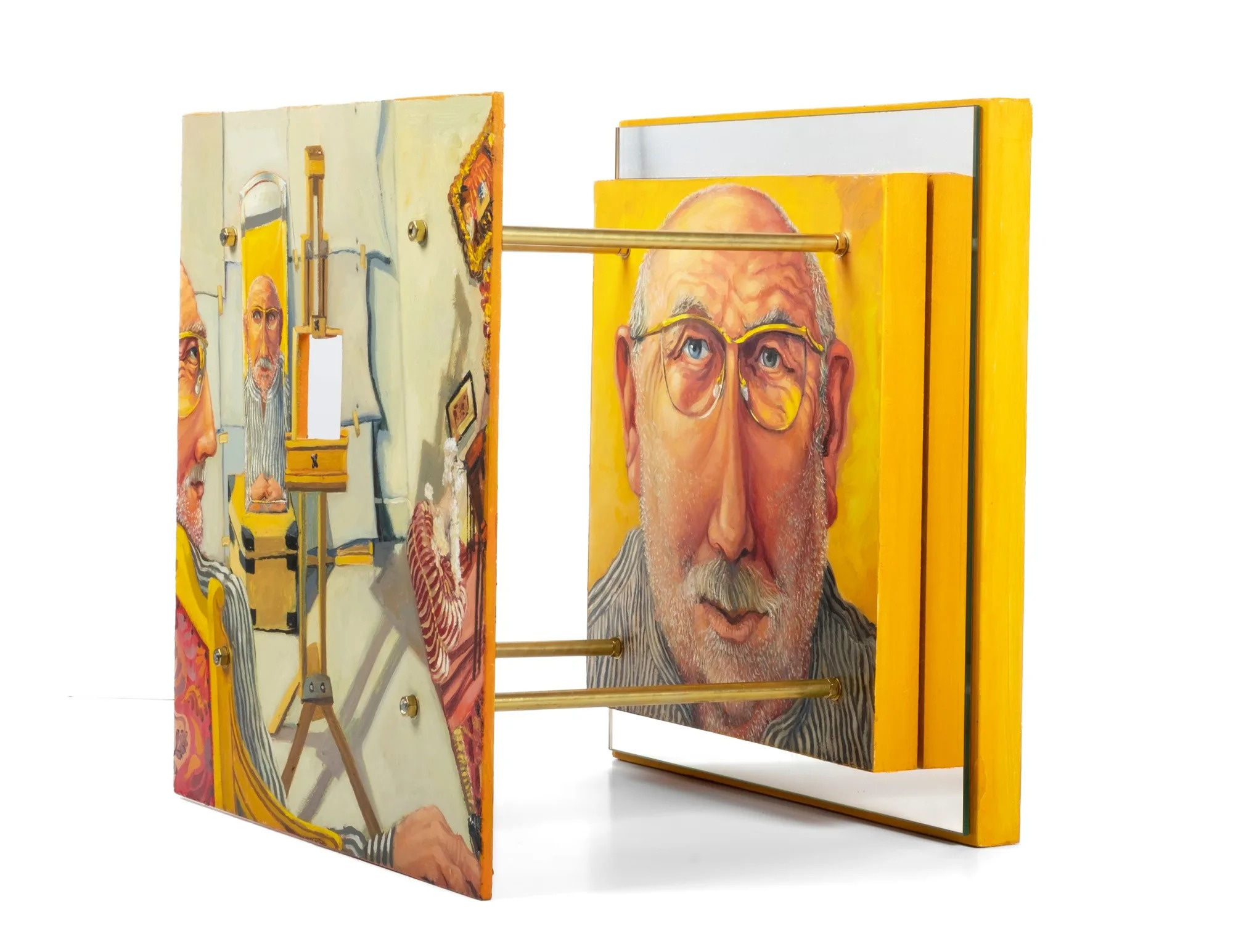
Self Portrait with Mirror by Anthony Green, NEAC Annual Exhibition 2022
Early NEAC members, like the French Impressionists, were also influenced by Japanese art and culture in the late 19th and early 20th centuries. In particular, James Abbott McNeill Whistler (elected in the 1890s) reflected this influence in his Nocturne scenes of the Thames, his portrait of his mother, and the Peacock Room.”
How have women shaped the NEAC’s history?
“Women artists were instrumental in challenging the British art establishment by introducing avant‑garde methods, bringing French Impressionism and Post‑Impressionism into the early to mid‑20th century. Since 1886, women have played a vital role in shaping the club’s identity.
Elizabeth Adela Forbes was celebrated for her technical versatility and poignant depictions of children and rural life. Clare Atwood captured the mood and feeling of life on the British home front during the First World War. Winifred Nicholson mastered colour and light with bold, distinctive paintings. Karn Holly, co‑founder of the NEAC Drawing School, helped cement the club’s educational legacy.

School Is Out by Elizabeth Adela Forbes (1859–1912), Penlee House Gallery & Museum, Image courtesy of Penlee House Gallery & Museum / Art UK
Other notable women include Ethel Walker, Mary Kent Harrison, Margaret Gere, Evelyn Cheston, Emily Beatrice Bland, Eleanor Fortescue Brickdale, Ann Le Bas, Dod Procter and Dawn Sidoli.”
What is the NEAC Annual Exhibition and why is it important?
“Since its founding, the NEAC Annual Exhibition has been the organisation’s core event. The first show was in April 1886 in London.
For nearly 140 years, the exhibition format has remained consistent: members display their work alongside selected public submissions chosen by the NEAC committee.
A 1904 photograph (as seen at the top of page) shows the NEAC selection committee at the Old Egyptian Hall, including Augustus John, William Rothenstein, Roger Fry, Muirhead Bone and Philip Wilson Steer.
Over the years, the NEAC has formed partnerships with museums and galleries across the country, including Mall Galleries in London, the Victoria Art Gallery in Bath, Chris Beetles Gallery in Mayfair, the Russell Gallery in London, and the St Ives Society in Cornwall.”

The NEAC Annual Exhibition 2021, photo courtesy of Mall Galleries
What is the NEAC Scholarship & Education Programme?
“Alongside our exhibition programme, the NEAC proudly runs its flagship scholarship and education initiative. This relatively new programme builds on our founding values.
The scholarship is designed for people who have had limited opportunities to engage with the NEAC, especially those facing financial obstacles in pursuing professional art careers. It offers scholars a platform to grow, develop and showcase their talent, helping them become part of the NEAC community. Together with our education programme, it sustains the lifeblood of the NEAC’s founding principles.”
What is the NEAC Digital Archive?
“Unlike other institutions, we do not have a permanent collection. Instead, we now maintain a digital archive with our official catalogue raisonné. The archive contains 441 folders on past members, compiled over 1.5 years from various online sources. It is actively updated and features monthly articles on members’ work, many of which have been published in our newsletters and on our website.”

Cover of the 1944 New English Art Club Exhibition Catalogue
What are some notable facts about the NEAC?
- "HM King Charles III is the Patron of the NEAC and often exhibits his paintings in its Annual Exhibitions.
- The NEAC was founded in 1886 — the same year Coca‑Cola was invented and the first Irish Home Rule Bill was introduced.
- Claude Monet and Gwen John both exhibited with the NEAC in its early years.
- The 2026 Annual Exhibition features almost 400 works.
- The NEAC holds a critics’ lunch before each Annual Exhibition at Mall Galleries, continuing a long‑standing NEAC tradition.
- Ethel Walker (1861–1951) was the first woman elected to the NEAC, in 1900.
- The Victoria Art Gallery in Bath has hosted NEAC exhibitions since the early 20th century, most recently in 2023.
- Paul César Helleu ( 1859–1927) was commissioned to design the iconic ceiling of Grand Central Station in New York City
- A selection of the NEAC’s physical archive is held in the Tate collection."
How can people support the NEAC today?
“We would love to continue for another 140 years! The NEAC is a registered charity supporting aspiring and established figurative artists through teaching, scholarships and exhibiting. You can support us by making a donation or becoming a Friend of the NEAC. Click here to find out how.
And, of course, be sure to visit our 140th Anniversary Exhibition at Mall Galleries from 11 to 20 June or view/buy online here."

Acknowledgements
Thanks to Neil Pittaway for his reflections on the NEAC’s development and ongoing role in British art.

